
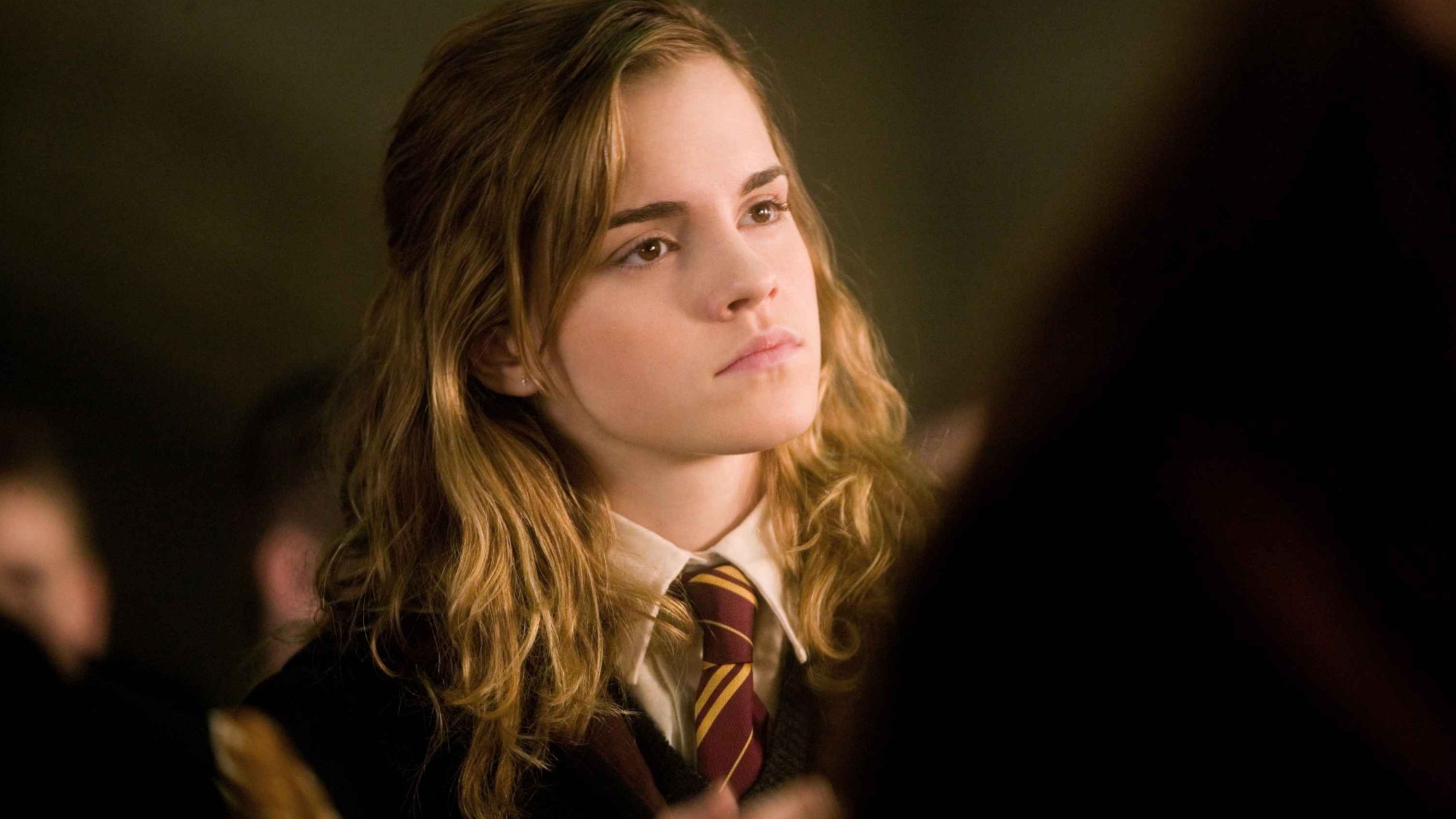
Hermione Granger is one of the most beloved characters in both the Harry Potter books and the movies. Out of all of The Golden Trio, Hermione had a unique representational weight as the only girl. Emma Watson was a fantastic Hermione, basically the character brought to life, growing up with much of the same scrutiny Hermione faced.
While Watson is the definitive Hermione for a generation, there is a sentiment among book readers that Hermione in the movies is a little too perfect. Harry and Ron are allowed to act their age, but Hermione is made even more absurdly knowledgeable in the films than in the books, often being given other Harry Potter characters’ lines.
In the Chamber of Secrets book, it is Ron, who grew up in the wizarding world, who explains the dark connotations of the slur “mudblood,” not Hermione. In the same book, Dumbledore wisely says that “fear of a name increases fear of a thing itself,” which sounds far more natural coming from him than Hermione.
Not only did the movies tend to make Hermione smarter, but they also simplified or eliminated some of her more complicated victories from later books. Making her more intelligent and less complicated flattened the character and took away some of her relatable flaws from the books.
The movies didn’t have enough time to give us every facet of Hermione, good and bad, but HBO's Harry Potter TV series will have time to go into more depth on every storyline and character. The new actress playing Hermione, Arabella Stanton, has already played Matilda in the West End, and there’s no closer approximation for young Hermione than Matilda.
Hermione’s arc over the whole series goes from blindly trusting authority and books to becoming a critical analyzer of information. She begins as someone who equates correctness with anything written in books or endorsed by institutions.
In Chamber of Secrets, that shows up in her almost automatic trust in Gilderoy Lockhart. She admires him because he is celebrated, published, and positioned as an authority, even developing an embarrassing crush that reflects her early belief that expertise and reputation are the same thing.
By Prisoner of Azkaban, that framework starts to crack. The truth about Sirius Black and the flaws in the Ministry’s narrative force her to confront the idea that official accounts can be wrong, incomplete, or actively misleading. It’s an early but important step toward intellectual independence: she begins to recognize that authority is not synonymous with truth.
That evolution deepens in Order of the Phoenix, where she is actively filtering information sources. The Daily Prophet’s credibility collapses for her as she recognizes its distortion and propaganda, and she starts seeking alternative channels of information.
At the same time, her resistance to Umbridge marks a behavioral shift. She goes from a rule-following student who views Hogwarts expulsion as a fate worse than death to someone willing to challenge institutional power directly when it conflicts with observable reality.
The later movies have to cut a lot to make the run time reasonable, but a lot of Hermione’s best, if most controversial, victories are removed entirely. S.P.E.W. (Society for the Protection of Elfish Welfare), her club to promote house-elf liberation, is the most commonly used example of a major Hermione book thread that is cut from the movies.
Hermione’s passion is admirable, but it is nuanced, since the house elves themselves don’t see themselves as oppressed. It’s a complicated dynamic to explore as a side plot in a movie, but the series will have the bandwidth to tackle storylines that aren’t as black and white.
A less commonly cited example of a cut story is Hermione's feud with Rita Skeeter in Goblet of Fire. She is determined to discover how Rita is uncovering actual secrets, and when she learns Rita is an unregistered Animagus, able to turn into a beetle, she literally traps her in a jar and holds her captive.
In the books, Hermione isn’t defined by obedience to knowledge structures but by her ability to question them, even when it’s uncomfortable or risky. The TV series will have time to show all the shades of Hermione Granger.
Goblet of Fire is the first time when hormones really enter the Golden Trio dynamic. Ron is late to recognize his feelings for Hermione, while Viktor Krum immediately registers her intelligence and curiosity.
Importantly, in the books, Krum’s interest isn’t framed as flashy attraction but as respect: he shyly follows her around the library, and their conversations cover everything but the Triwizard Tournament. Their connection is awkward, tentative, and shaped by adolescence rather than spectacle, and it continues through letters even after the school year ends.
For unclear reasons other than expedience and humor, the Goblet of Fire movie inverts their relationship, making it something weirdly sexual instead of respectful. In the movie, Hermione says exactly the opposite of what she says in the books, saying that she and Krum barely talk and giving a salacious giggle.
Perhaps the more pressing issue is the natural chemistry Emma Watson had with Daniel Radcliffe in the later movies. Even though Hermione was destined to end up with Ron, Harry and Hermione had a bond on screen that didn’t feel as brother-sister as it did in the books.
Harry Potter Golden Trio Movie & TV Show Casts
It doesn’t help that Ron is absent for a good chunk of Deathly Hallows, Part 1, and Harry and Hermione share this very intimate dance that is entirely a movie creation. A major problem is that many of the reasons Hermione falls for Ron are cut out of the movies as well.
Hermione’s love life is one of the clearest areas where a long-form TV adaptation can add real depth simply by having time to let relationships breathe instead of compressing them for runtime. With more time to give Hermione and Ron more complete arcs, their journey to each other romantically will feel more natural in the Harry Potter TV show.