Game of Thrones is that show with the dragons and people dying, plus some other stuff. But the dragons do – and did – get a lot of attention, perhaps second only to all the death. Game of Thrones was a series that did, after all, always emphasize danger and stakes, with its overall narrative, establishing that infamously early on, and then having some early deaths lead to greater conflicts: namely, the War of the Five Kings, which drove a great deal of conflict and bloodshed between various families/factions throughout Westeros.
And then there was also a potential queen, who wants to reclaim the throne, beginning outside Westeros (Daenerys Targaryen), and a more existential threat to the North of the kingdom of Westeros, owing to an undead army slowly approaching (the whole “winter is coming” thing). So, lots of danger, and all of it leads to a good deal of conflict and action. There are some amazing battle sequences, and a few other memorable small-scale fights, throughout Game of Thrones, with the best one from each season mentioned below. Some seasons have more action than others, so a few of these were harder to decide on than others. Also, this is just sticking to the eight seasons of Game of Thrones, so no House of the Dragon or A Knight of the Seven Kingdoms (though the former has definitely presented some impressive action and spectacle so far).
The first season of Game of Thrones is pretty great, and you do know you're in good hands fairly early on. That being said, not as much action here. That’s okay, because the setup is consistently interesting, and the focus on drama (good quality drama, at that) is more than enough. It’s more or less forgivable when Tyrion gets knocked unconscious at the start of a battle in the ninth episode, “Baelor,” even if he stays conscious in the book version of that same sequence, and honestly kicks quite a bit by way of ass.
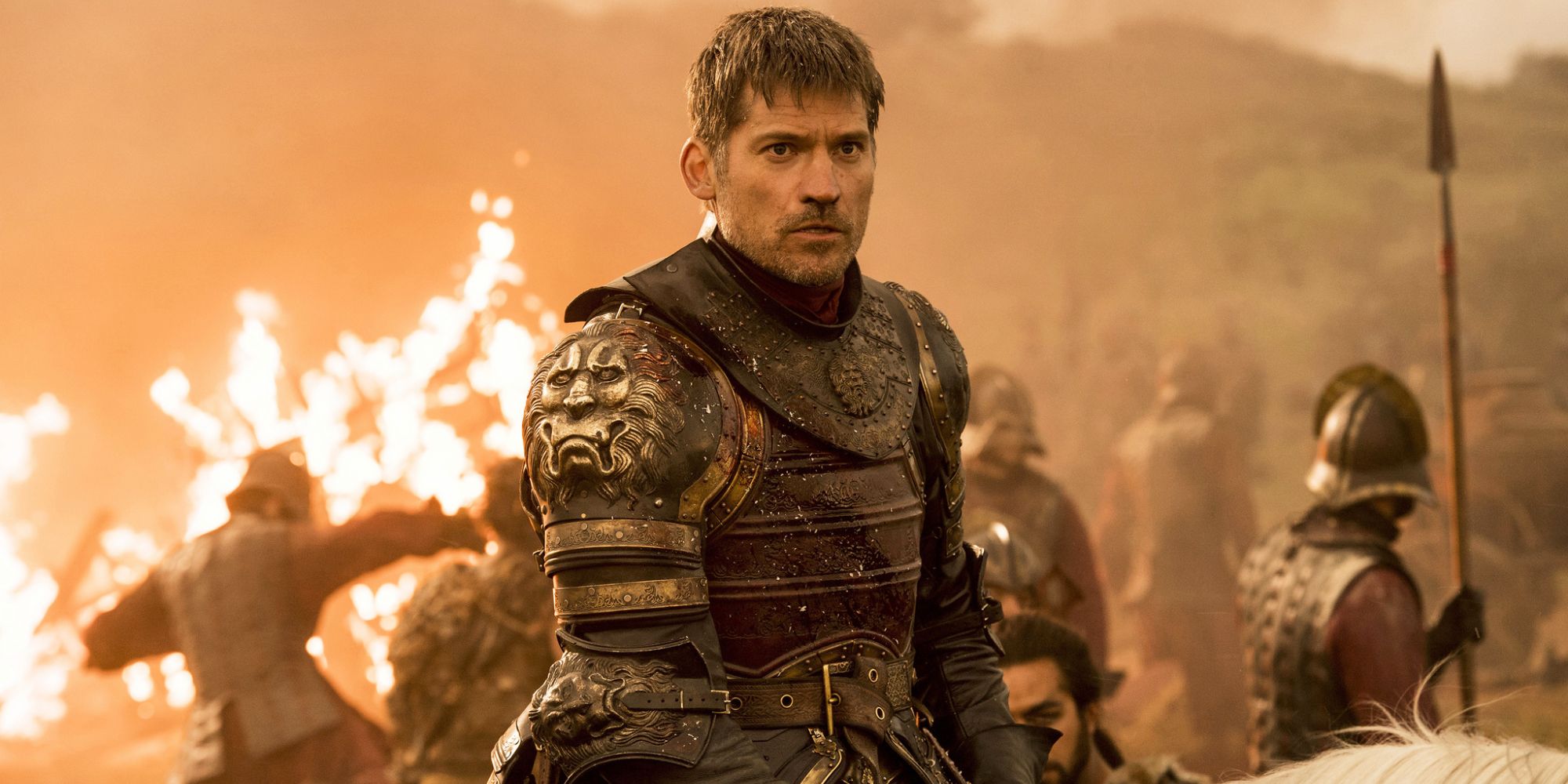
Okay, so it would've been better to see that battle. “Baelor” ends with a certain scene that makes the rest of the episode feel a bit overshadowed, as it’s the inciting incident, basically, for the War of the Five Kings. So, for action, you’ve got a few smaller sequences, including the ambush that leads to a one-on-one duel between Jaime and Eddard at the end of episode #5, “The Wolf and the Lion.” It’s neat to see the latter hold his own against the man known as the Kingslayer, and as for said Kingslayer, it’s a good showcase of his fighting ability (and he does go on to be at the center of quite a few impressive action sequences in later seasons, too).
To make up for the lack of a big battle in “Baelor,” it seems, Game of Thrones spared no expense in depicting the biggest battle in the second book in the Song of Ice and Fire series: A Clash of Kings. Those kings do be clashing, with two of the five in the War of the Five Kings meeting – and fighting – in the Battle of the Blackwater, which makes up essentially the entirety of the season’s penultimate episode, which is fittingly just called “Blackwater.”
“Blackwater” is the boldest episode of the second season, and it helps set a precedent for the penultimate episode of each Game of Thrones season being wild, since the aforementioned “Baelor” was also the penultimate episode; in that instance, for season 1. Game of Thrones had definitely felt cinematic before “Blackwater,” but this was the first time a battle sequence had been done that could match the sorts found in various blockbusters from the past decade or so. It was cinematic well beyond the bounds of television, even by HBO standards, and it definitely wouldn’t be the last time Game of Thrones featured a battle sequence that was pretty much at the level of some of the action seen in films like The Lord of the Rings, Troy, and Kingdom of Heaven.
Season 3 of Game of Thrones feels a little in line with season 1, in terms of drama being emphasized over action. That’s still okay, though, and part of it comes about from this third season being an adaptation of about half of one of George R.R. Martin’s books: A Storm of Swords (2000). That one was massive, and half of the book ended up being enough. It’s just sort of the case that a lot of the action-heavy parts of that book ended up being adapted in season 4.
Of course, in season 3, you do have “The Rains of Castamere,” so things certainly happen, just not really with much large-scale combat or properly big battles. So, here’s a smaller scene: Brienne being forced to face off against a bear, and Jaime (now without his right hand), jumping into the pit she’s in to help, and trying to rescue her. It’s more impressive and memorable for Jaime’s character arc, and what it means for him and Brienne, but they are also facing off against a bear, which is undeniably tense and kind of exciting, too. At least, it’s sufficiently action-y, at least by this season’s standards.
Things do get a bit more blockbuster-ish with season 4, owing to A Storm of Swords really taking off in its second half, and that second half is basically captured/adapted here. On that note, there’s another penultimate episode here that’s quite grand, with “The Watchers on the Wall” having a large-scale battle that rivals the battle seen in “Blackwater.” Perhaps unsurprisingly, both episodes had the same director: Neil Marshall, who’s otherwise best known for horror movies like The Descent and Dog Soldiers.
That title does refer to the main fight in question, and if you’ve seen it, you might not like it, but you'll probably understand why it’s here.
But the most memorable action scene of season 4 is a slightly smaller one, and takes place an episode earlier: in the eighth of ten, “The Mountain and the Viper.” That title does refer to the main fight in question, and if you’ve seen it, you might not like it, but you'll probably understand why it’s here. It’s a difficult one to forget, for better or worse (okay, mostly for worse).
Another third-to-last episode, “Hardhome” is the third absolutely massive battle-focused episode of the series, and it’s noteworthy for being the first that involves the army of the dead. It’s also noteworthy for being the first big battle in the show that wasn’t featured in one of the first five books in A Song of Ice and Fire, as season 5 was around the time the show caught up to the books (with season 6 well and truly passing the five books, of a planned seven… if the series will ever get finished).
“Hardhome” also succeeds in being heavy-going alongside feeling grand and quite “epic,” for lack of a better word. It establishes the Night King and his forces as a truly intimidating threat, well beyond what had been seen – or hinted at – before. The undead army showed, rather than told. And the show, you know, showed the threat they posed, more than just telling. It’s naturally important for the final few seasons of the show, too, since the War of the Five Kings is winding down at this point, and various characters become more focused on the seemingly inevitable invasion of Westeros by the army of the dead.
There’s a good deal of catharsis to be found in “The Battle of the Bastards,” even if the Starks have to suffer one more loss before it happens. One of the titular “Bastards” is Ramsay Bolton, who has, of course, been an absolute monster for several seasons, until this point, and the plot armor he honestly kind of had for much of that time is finally pierced here.
Beyond that, and the one-on-one fight he has with the other “Bastard,” Jon Snow, “The Battle of the Bastards” goes big and feels dramatic, being perhaps one of the grittiest and most brutal fights showcasing a medieval sort of combat, maybe ever? Like, it feels easiest to compare to something like Braveheart, or some of its particularly intense moments feel even a little reminiscent of Saving Private Ryan (well, maybe “The Battle of the Bastards” does for this kind of warfare what the opening of Saving Private Ryan did for World War II-era combat).
So, season 7 progresses things quite a bit with Daenerys, since it sees her arriving in Westeros, and she still has all three of her dragons at this point. The mid-point of the season, “The Spoils of War,” has her taking one of the dragons into a large-scale battle, alongside her army of Dothraki warriors, and it is truly impressive stuff, partly because it feels a bit like it came out of nowhere.
Well, not entirely out of nowhere. But Game of Thrones had established a pattern of big battles being featured in either the third-to-last or penultimate episodes of each season. Here, it happens during the fourth (of seven) episodes. It does rival all of those other big battles mentioned previously, even if Jaime now seems to be wearing the plot armor that Ramsay had been wearing before (him charging a dragon is a cool visual, but he probably shouldn’t have survived… still, that aside, it’s a phenomenal sequence).
You're never going to please everyone, if you have to praise some part of the final season of Game of Thrones, since the final season of Game of Thrones is so controversial. There are big moments here for sure, but they're not handled as well as the big moments from past seasons. Even season 7, for its flaws, had that battle in “The Spoils of War,” which is an overall stronger set piece than anything from season 8 (again, even with the potential implausibility of no main characters dying).
The best action sequence of the final season should’ve been the battle against the army of the dead in “The Long Night,” but it was no “Hardhome,” since it just wasn’t well-lit. And it had some baffling moments in terms of strategy, or lack thereof, regarding both sides. So, here’s “The Bells.” The whole sequence involving the attack on King’s Landing, and the destruction of it, is stunning in terms of sheer spectacle. There is a lot to be said – and criticized – regarding the way the events of the episode are built to, and plenty of moments of character drama within the overall set piece feel rushed. Still, on a technical front, this is a huge, not to mention largely well-filmed, sequence. If it had felt a bit more appropriate within the overall narrative, and on a thematic front, then “The Bells” could've been held in similarly high regard to plenty of the other penultimate episodes found throughout Game of Thrones. Oh well.