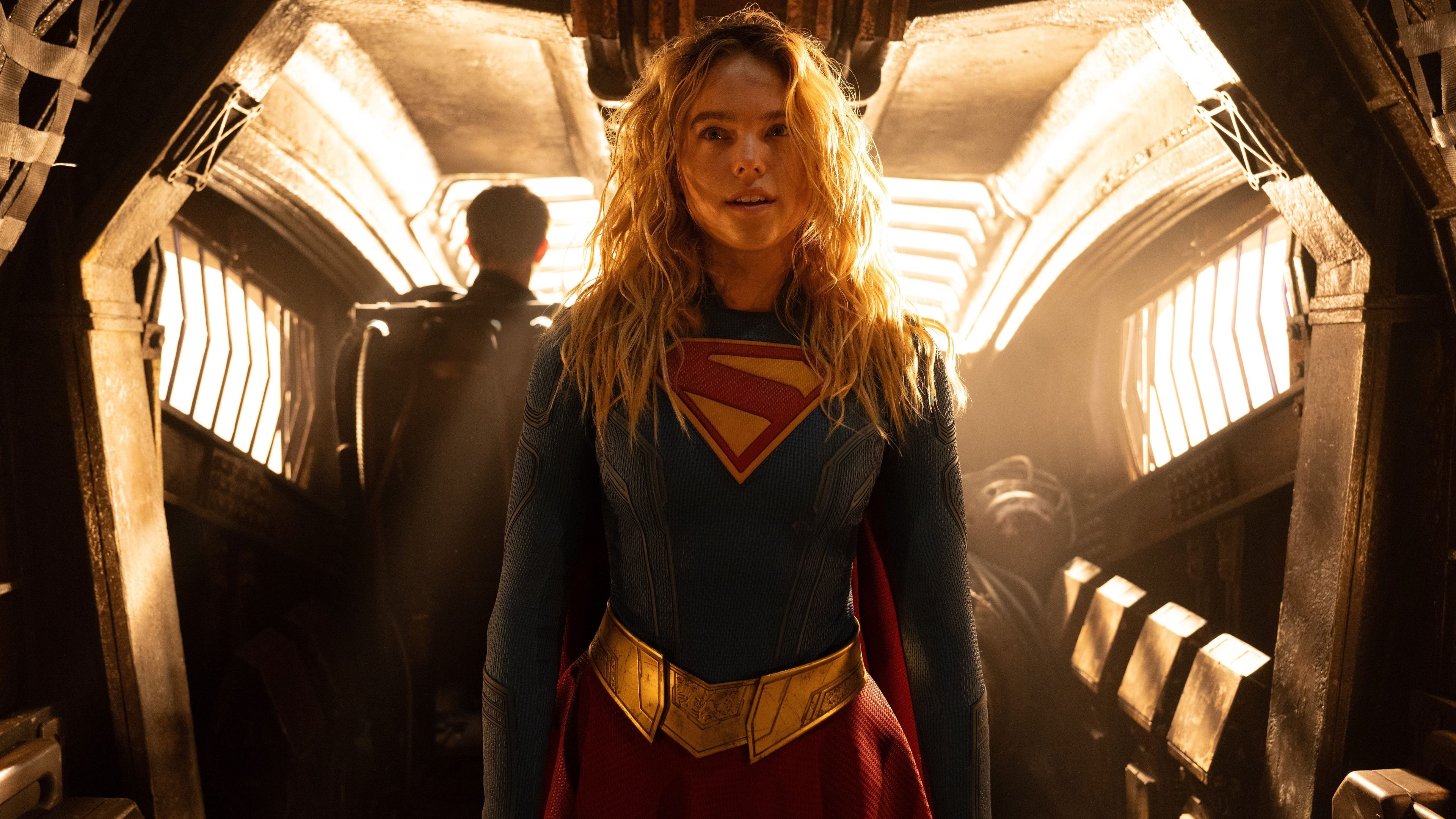

In “Supergirl,” a melodramatic cover of Jimmy Eat World’s “The Middle” scores a climactic battle sequence, with the song’s lyrics meant to offer encouragement to the plucky heroine: “Hey, don’t write yourself off yet…”
Yet the initial box office results for “Supergirl” would suggest that audiences are, in fact, writing off the film — and continuing to reject lesser-known comic book protagonists. The Warner Bros. and DC Studios adaptation, which centers on Superman’s cousin Kara Zor-El, misfired with $38 million in North America and $68 million globally in its opening weekend. After launching below expectations, the big-budget film is shaping up to be a money loser for the studio, as well as a major setback for the newly rebooted DC Universe.
Warner Bros. and DC spent $170 million to produce and roughly $120 million to market the comic book adventure, which takes place in outer space as Supergirl and an alien girl named Ruthye embark on a quest for vengeance and justice. Those lackluster initial ticket sales are concerning because “Supergirl” hasn’t been widely embraced by the general public, and there’s intense competition during the height of summer movie season, which could hobble the film’s box office staying power. Next weekend sees the release of another family-friendly film, Universal’s animated “Minions & Monsters,” while Disney’s live-action “Moana,” Christopher Nolan’s “The Odyssey” and Sony’s “Spider-Man: Brand New Day” round out the month of July.
“This was always going to be a tough hurdle for DC and Warner Bros. because Supergirl isn’t a character that has ever created an event-level blockbuster,” says analyst Jeff Bock of Exhibitor Relations. “Audience perception of ‘Supergirl’ was not good. This is just a case of the film wasn’t good enough to become an event.”
Traditionally, a movie on the scale of “Supergirl” would need to earn at least $375 million to break even because theater owners get to keep about half of box office returns. However, a source close to “Supergirl” puts the film’s breakeven number at closer to $300 million.
“Supergirl” is projected to stall at a lifetime gross of $100 million domestically and $200 million to $210 million globally. If the movie reaches those metrics (and that would require a decent hold), “Supergirl” stands to lose $100 million to $120 million in its theatrical run, according to sources with knowledge of the economics of similar films. A source familiar with the financials of “Supergirl” believe the losses will be closer to $80 million to $85 million, assuming that worldwide ticket sales reach at least $200 million. Warner Bros. faces an even larger write-down should “Supergirl” fail to hit $200 million by the time the film leaves the big screen. It’s the second notable flop in 2026 for Warner Bros. following this spring’s “The Bride!” which flatlined with $23 million worldwide against a $90 million budget. The studio had two modest wins with February’s “Wuthering Heights” and April’s “Lee Cronin’s The Mummy,” but so far its track record has failed to match the impressive run in 2025 when films like “Sinners,” “A Minecraft Movie” and “Weapons” topped charts.
Sources close to the production say “Supergirl” has a lower breakeven point than a typical film of this size because the cast and creatives don’t have backend deals. A-listers like Joaquin Phoenix and Lady Gaga (the stars of 2024’s bomb “Joker: Folie à Deux”) can negotiate first-dollar gross, meaning that in addition to their multimillion dollar salaries, they receive a percentage of box office revenue before the studio recoups any costs. That’s not the case with “Supergirl,” which stars “House of the Dragon” breakout Milly Alcock in her film debut. She was paid around $400,000 to play the eponymous character and would have received only a small box office bonus if the film were successful.
“Supergirl” is the follow-up to last summer’s “Superman,” which restarted the Warner Bros-backed DC Universe under the direction of James Gunn and Peter Safran. Buoyed by strong reviews, “Superman,” starring David Corenswet as the Man of Steel, launched to $125 million and eventually earned $618 million globally. Those returns were deemed a hit at a time when the superhero genre has been showing signs of wear and tear.
After the debut of “Superman,” Warner Bros. Discovery’s CEO David Zaslav championed the “bold 10-year plan” of the new DC Universe, saying the “vision is clear, the momentum is real.” Yet that kind of celebration may have been premature; the sluggish start for “Supergirl” underscores the real challenges that come with building an interconnected film franchise — especially one that’s attempting to rival Disney’s Marvel Cinematic Universe.
“While ‘Supergirl’ didn’t meet our box office expectations, it’s just one component of a broader, long-term strategy at DC Studios that we remain confident in,” Safran told the New York Times.
Before the pandemic, superhero movies of all shapes and sizes were seemingly untouchable at the box office because audiences would reliably buy a ticket no matter who was on screen. Even Sony’s 2018 “Spider-Man” spinoff “Venom,” which was saddled with comically terrible reviews, was a juggernaut with $856 million worldwide. After dominating in theaters for nearly two decades, comic book adaptations are no longer bulletproof. Now, moviegoers have become more selective about their costumed heroes. The MCU, too, has struck out in post-COVID times with films that center on lesser-known heroes, including 2025’s “Thunderbolts” or “Captain America: Brave New World.”
“We’ve seen so many superhero movies, but I hesitate to label it as fatigue,” says Shawn Robbins, director of movie analytics at Fandango and founder of Box Office Theory. “It’s a fatigue of seeing the same type of movies. Audiences don’t inherently want superheroes to be part of a universe. They want to see something different.”
The poor start for “Supergirl” doesn’t mean it’s over for DC Studios or superhero adventures in general. Marquee characters, who basked in the spotlight in hits like 2022’s “The Batman” and 2024’s “Deadpool & Wolverine,” remain wildly popular. Sony’s “Spider-Man: Brand New Day” (July 31), a sequel to 2021’s juggernaut “No Way Home,” and Disney’s “Avengers: Doomsday” (Dec. 18), are expected to be two of the year’s highest-grossing releases. And DC should score with next summer’s “Superman: Man of Tomorrow,” a sequel that brings Corenswet’s Clark Kent back to the forefront.
“There will always be superhero movies, but genres ebb and flow over time” Robbins says. “We’re entering an era where superhero movies are going to be more selectively produced.”
And when studios do greenlight movies about comic-book characters who aren’t household names, they’ll need to economize on the production budget and marketing spend. Analysts say a film about Supergirl can’t cost the same amount as the next “Batman” or “Superman,” who are DC’s two biggest A-listers. One reason that 2019’s billion-dollar smash “Joker” was so profitable was because the origin story about the notorious villain was made for just $55 million. Box office watchers are encouraged that DC’s next effort, the body-horror film “Clayface” (Oct. 23), carries a modest $40 million production budget.
“Superhero movies can still be marketable, but studios need to ask themselves, ‘Are casual moviegoers going to our film?’ When you are spending $150 million to $200 million, it needs to feel culturally inevitable,” Bock says. “Otherwise, smaller films with less risk is the way to go.”