
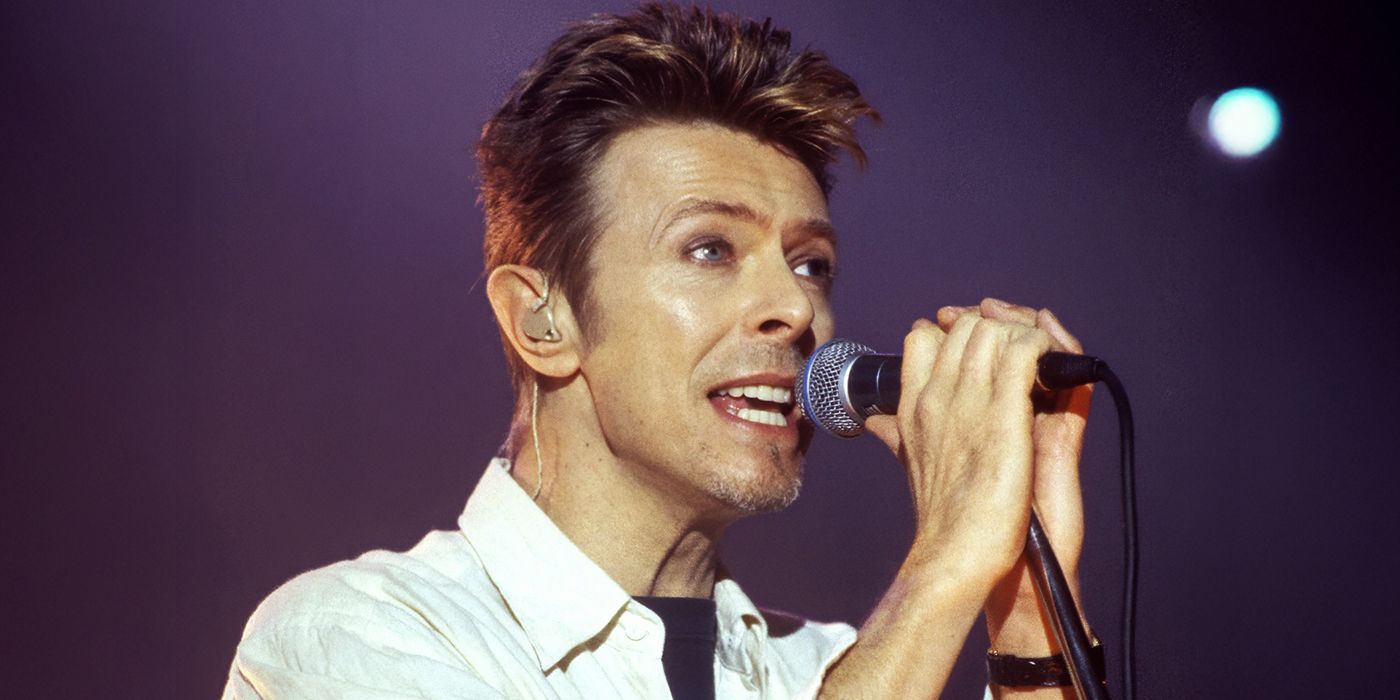
In the 1980s, David Bowie went through one of his many reinventions. With elements of disco and new wave, Bowie's 1983 album, Let's Dance, became an icon of the '80s, but while most of the songs in it invite listeners to dance and let go, Bowie was going through different transformations, some of which were very painful. He suffered a devastating loss, changed his team, and found himself again in this new era, as he did every time he changed styles in his incredibly prolific career.
"Modern Love" is one of David Bowie's greatest hits, and it's one of those songs that can deceive the listener at first. Bowie's upbeat voice and funky rock rhythm immediately make you bob your head, but as soon as you pay attention to the lyrics, it's clear that the British singer was working through his own feelings of disappointment with the modern world and the perception of romance. Here's why this classic dance song is actually one of Bowie's most heartbreaking ones.
David Bowie's album Let's Dance came out in 1983, but Bowie had been working on the songs from the album for many years before it came out. In 1980, the singer had started working on the album, but then, in December, tragedy struck. As everyone knows, that year, former Beatle John Lennon was shot and killed just outside his home in New York. He was Bowie's long-time friend and collaborator. Lennon even helped him write the song that became his first U.S. No. 1 hit. So, when he heard the devastating news that his friend had been murdered, he put all his plans on hold. He canceled his upcoming tour and fled to Switzerland, where he withdrew for several months, processing his grief and slowly trying to recover.
Based on your personality, energy, and taste, the classic rock band that matches your soul is…
You are pure, undiluted rock energy. You don't need tricks, trends, or theatrical gimmicks — you have something more powerful: a riff that hits like a thunderbolt and an attitude that never wavers. Like AC/DC, you understand that simplicity executed with absolute conviction is its own form of genius. You're the person in the room who doesn't overthink it, doesn't pretend, and never turns the volume down. The highway to hell is a state of mind — and you've been on it since day one.
You've got swagger that can't be taught. Rooted in the blues and soaked in street-level attitude, you move through life with a loose, dangerous elegance that draws people in without ever trying too hard. Like the Stones, you've seen it all, done most of it, and somehow look better for it. You're not chasing perfection — you're chasing truth, groove, and that electric moment when everything clicks. Can't always get what you want? You tend to get it anyway.
You go hard or you go home — and you almost always go hard. Intense, dedicated, and fiercely loyal to what you believe in, you don't do anything halfway. Like Metallica, your passion runs deeper than most people's will ever go, and when you care about something, it shows in every detail. You're drawn to darkness not because you're cynical, but because you're honest — and honest people know the world isn't always pretty. Enter Sandman. Nothing else matters. That's your philosophy.
You are magnificent, and you know it — not from arrogance, but from an unshakeable sense of self that has never needed anyone's permission. Like Queen, you defy every category people try to place you in. You blend the epic with the intimate, the operatic with the anthemic, the serious with the playful. You live boldly, love fiercely, and perform every aspect of your life as though the whole world is watching. Because sometimes it is. We are the champions — and so are you.
You have the rarest of gifts: the ability to make something that feels both deeply personal and universally human. Like The Beatles, you're a natural connector — someone whose warmth, curiosity, and creative instincts draw people together across every divide. You believe in melody, in craftsmanship, and in the quiet power of a song that says exactly what someone needed to hear. You've changed the people around you just by being who you are. All you need is love — and you give it generously.
Lennon hadn't only been his close friend; he was also his greatest mentor. Although they were only a few years apart, Bowie grew up listening to The Beatles, and Lennon was one of his most important inspirations. “A whole piece of my life seemed to have been taken away," Bowie said about Lennon's death, "a whole reason for being a singer and songwriter seemed to be removed from me. It was almost like a warning.”
But while the loss was a heavy thing to process, Bowie knew that, despite losing his mentor, he still had a lot to give. A couple of years later, he decided to go back into the studio. But the experience had changed him, and as such, his new album needed to reflect that.
"Modern Love" was the third single from Let's Dance, and it's a clear change of direction for Bowie. The British musician was channeling his disillusionment with romance, and the modern world in general, through this song. When he returned to the studio, Bowie was ready to shake things up. He broke a long-time partnership with producer Tony Visconti, hiring R&B legend Nile Rodgers instead, which caused a lot of tension with his then-collaborator. According to Visconti, Bowie chose Rodgers instead of him because "he wanted that elusive number one American hit."
This seemingly cheery song hides John Lennon's deepest fears.
"I said, 'Well, I guess we’re not going to work together anymore. But good luck. Congratulations. Let’s Dance is a big hit.' I personally never liked it. It’s just not David Bowie," the producer said. It's understandable why he would say this, considering he worked with Bowie throughout the '70s, and his music during that decade couldn't be more different from Let's Dance. But it would be a mistake to try to say that there's a single "David Bowie style." After all, Bowie's essence as an artist was his ability to constantly change and grow with the times, and "Modern Love" was a great reflection of its time, and of what Bowie was feeling during that time.
In this song, Bowie condemns modern romance, claiming, "It's not really work, it's just the power to charm." In the chorus, he also says, "I don't believe in modern love." This sense of dismay might also have to do with the fact that he had recently divorced, and going back into the dating world, he found himself disappointed with how romance had changed.
"Modern Love" is the opening track of the album, and introduces the world to this new chapter in David Bowie's career, proving disco was yet another genre that the Thin White Duke expertly managed.