If you had a quarter for every Spider-Man comic being released this year that is either attempting to capitalize on Marvel Cinematic Universe/Spider-Man: Brand New Day synergy or reflect on Spider-Man’s more nostalgic, decades-old eras in the mainline Amazing Spider-Man series, you’d have quite a few quarters. For instance, J. Michael Straczynski and Pere Perez’s The Amazing Spider-Man: Torn miniseries revisits Peter Parker’s days at Empire State University and Mary Jane Watson/Gwen Stacy love triangle, while Christos Gage and Edgar Salazar’s Civil War: Unmasked miniseries seeks to flesh out and add clarity to Marvel’s first Civil War event.
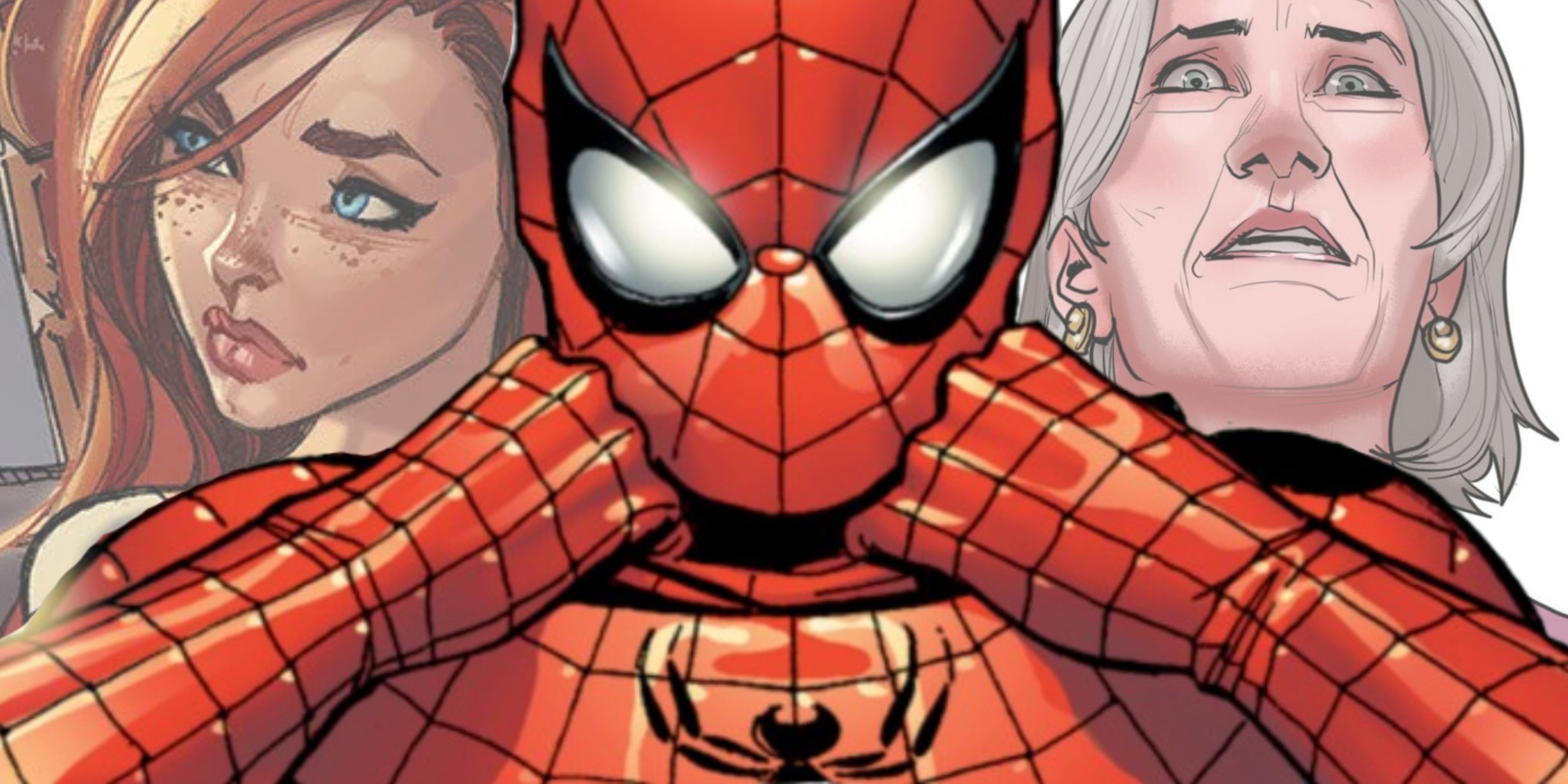
Civil War: Unmasked is plainly nostalgic, and, in Spider-Man’s case, it’s largely because Peter’s status quo is back to what it was during Straczynski’s beloved Amazing Spider-Man era: he’s a teacher at Midtown High, married to Mary Jane Watson, and his Aunt May already knows he’s Spider-Man. Issue #2 dives wholly into Peter’s decision to publicly reveal his identity as Spider-Man after supporting Iron Man and the Superhuman Registration Act passing as law in Civil War, reinforced by the two loved ones who he was closest to at the time.
The consequences of Peter’s unmasking in Civil War (2006) #2 affected Aunt May almost instantly, and the Parkers’ lives spiraled uncontrollably thereafter until the “Brand New Day” status quo rewrote and regressed them. Peter even acknowledges the possibility of villainous organizations or individuals hunting his family the moment he reveals his identity, which is more or less precisely what happens, inciting the subsequent “Back in Black” storyline.
Here, a hitman, hired by Wilson Fisk’s Kingpin, attempts to assassinate Peter, but misses the shot when Peter dives out of the way, hitting Aunt May instead. Wearing the black cloth Spider-Man costume, Peter’s violent pursuit of his aunt’s potential killer leads him to Kingpin, whom Peter threatens to kill if May dies.
Civil War: Unmasked #2 reiterates that MJ and Aunt May were fully supportive of whatever choice Peter made, whether he was going to be Pro-Registration and reveal his identity or not, denying him the ability to shirk the accountability of his decision-making onto them. Nonetheless, two decades later, Aunt May stating how proud she is of Peter in Civil War: Unmasked #2 is little more than a gut punch when it’s become clear that Peter unmasking was one of the worst mistakes he ever made, especially when Marvel went ahead and retconned it not long afterward via Peter’s deal with Mephisto and the joint efforts of Doctor Strange, Iron Man, and Mister Fantastic.
It’s ironic that MJ says, “You worry too much about us. You’re the one dodging pumpkin bombs and scorpion tails” in Civil War: Unmasked #2 when Peter obviously had every right to be concerned about his actions affecting her well-being (presently and retrospectively speaking). Following Peter’s public unmasking, Morris Bench’s Hydro-Man is hired by the Maggia to attack the Daily Bugle for “having the web-head on the payroll,” demonstrating how quickly Spider-Man’s enemies would leap at the opportunity to hurt Peter and anyone he’s associated with.
Once Peter defects from Iron Man’s Pro-Registration authoritarianism to Captain America’s Anti-Registration resistance, it would’ve been fascinating to see how Peter and MJ tackle being fugitives and public figures further. However, Civil War and The Amazing Spider-Man barely get to explore that before Peter’s egregious deal with Mephisto erased Peter and MJ’s marriage.
Nearly 20 years later, it is interesting to imagine how MJ’s life might’ve taken shape if she had been simply and happily married to Peter. Rather, she has startlingly become the All-New Venom, having willingly bonded with the black alien symbiote, and only appears to ever want a platonic friendship with Peter, for better or worse.
Civil War: Unmasked #2 even fleetingly addresses the idea of Peter and MJ having a family, which readers are no less sore about, either. It is undetermined what became of Peter and MJ’s child, Mayday, who was thought to be stillborn but revealed to be kidnapped by Norman Osborn in the 1990s “Clone Saga” storyline.
Of course, whether their child is still alive to this day or not in Marvel’s mainline Earth-616 canon is now immaterial, as Mephisto’s deal in “One More Day” reveals that the existence of Peter and MJ’s baby would be erased along with their marriage. Civil War: Unmasked #2 then pours salt on that wound by seeing MJ admit she’s open to a future where they try to start a family again, knowing that any future with Peter, in general, will soon be robbed from her:
“I know what you’re saying, Peter. And I’m not ready to think about… a family yet. But it would be nice to be in a position to think about it someday.”
Peter and MJ being torn apart during the events of the “One More Day” storyline only happens because Aunt May was mortally wounded, which was due to the events of Civil War. This means that Marvel’s Civil War crossover event is fully to blame for everything that transpired regarding Aunt May and MJ, as well as the status quo change for Spider-Man that Marvel has staunchly honored after all these years.
Civil War: Unmasked #2 touches on how Peter ultimately decided to reveal his identity in order to provide his family with financial security, but none of Peter, Aunt May, and MJ’s conversations make that much of a difference within the context of the original event. It is nice to hear more logic and reasoning in terms of the “pros and cons” that Peter, Aunt May, and MJ had considered, and yet all that their optimism and faith achieve is a more traumatic outcome when readers know what tragedies ensue in their near future, relative to Civil War.
Civil War: Unmasked #2 reflects on an era where Spider-Man’s sense of responsibility was horribly botched, and the blame is cast entirely on him for the ramifications of his actions. Even with the best intentions, as Civil War: Unmasked #2 argues, Civil War and “One More Day” punctuate how severely Peter and the Parkers were affected by his choices.
Spider-Man is the name given to several individuals who have employed a spider-moniker throughout Marvel Comics. Typically gaining their powers through a bite from a radioactive spider, the different Spider-Man heroes employ super-strength, agility, and intellect while utilizing webbing to swing and tangle up their foes. The most notable of these Spider-Men is Peter Parker, who remains one of the most popular superheroes throughout the world.