The science fiction genre has seen the birth of numerous science fiction franchises over the years, from Star Wars and Star Trek to cult classics like Babylon 5. One of the most underrated is the Stargate franchise, which officially kicked off with Stargate: SG-1. Showrunners Brad Wright and Jonathan Glassner deserve credit not only for launching a series that continues to hold a dedicated fanbase 25 years after its inception but also for having that series serve as a launching pad for a whole franchise. While it's common for shows like Peacemaker and Loki to spin out of feature films, SG-1 didn't have the luxury of a streaming service or an era where genre fare was commonplace. Its origin story boils down to unexpected success.
SG-1 sprung into being due to a deal between Showtime and MGM Studios, with the latter owning the rights to the Stargate film. With Stargate proving to be a massive success at the box office, director/co-writer Roland Emmerich and his creative partner Dean Devlin pitched two more Stargate films. Each of the proposed sequels would have delved into the origin of various myths in Earth culture, and revealed that the chyrons on the Stargate were in fact coordinates to other alien worlds. "Whether it was Bigfoot, or the Yeti — we were going to tie everything together into a larger mythology. And it was going to be so much fun. It was going to be so wild," Devlin said during an interview for the Dial the Gate podcast.
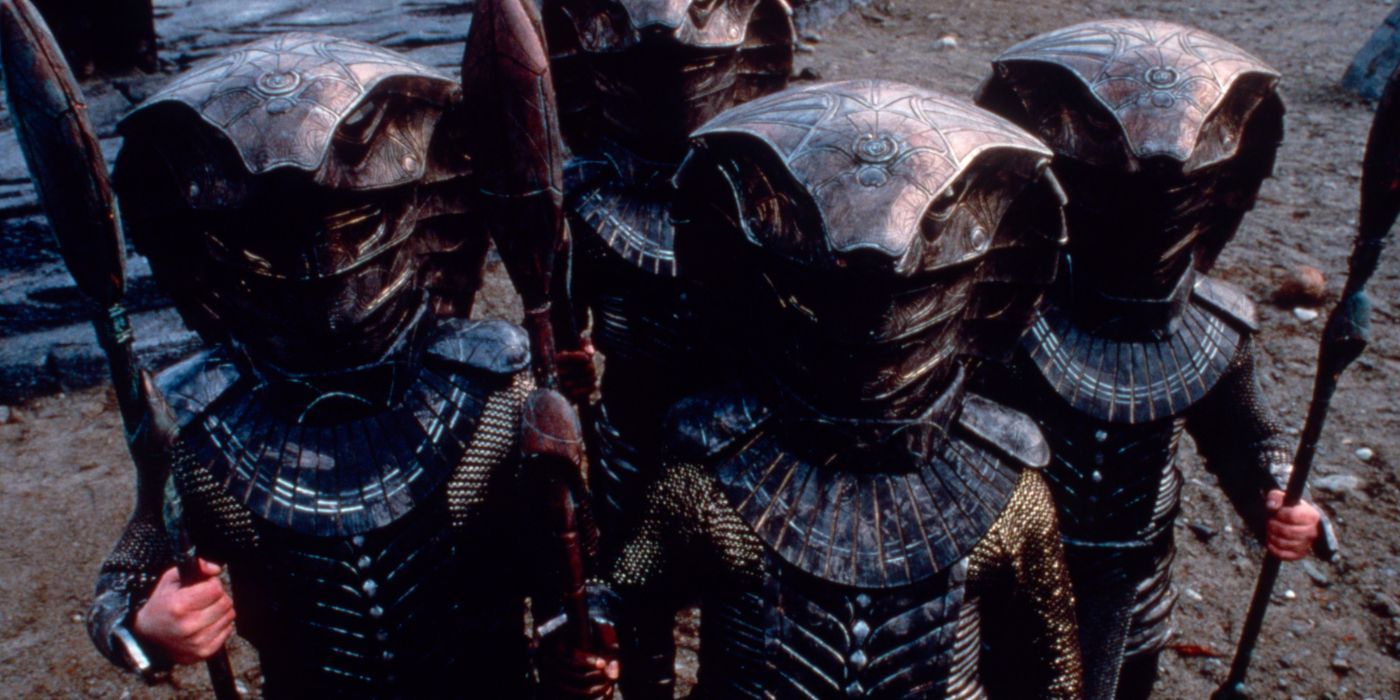
Those films never came to be as MGM saw more value in a television series. The network hired Wright and Glassner, who'd previously worked on the Showtime revival of The Outer Limits. Together, they crafted a story that took place roughly one year after the events of the Stargate films and saw the return of protagonists Jack O'Neill (Richard Dean Anderson) and Dr. Daniel Jackson (Michael Shanks). O'Neill and Jackson become part of a specialized "SG" team that also includes tech genius Samantha "Sam" Carter (Amanda Tapping) and the mysterious alien warrior Teal'c (Christopher Judge). Throughout SG-1's entire run, the team would utilize the Stargate to travel to other worlds and confront interstellar threats such as the shapeshifting Goa'uld.
Your answers point to the world your instincts were built for. This is the universe your temperament, your survival instincts, and your particular brand of stubbornness were made for.
You took the red pill a long time ago — probably before anyone offered it to you. You're a systems thinker who can't help but notice the seams in things.
The wasteland doesn't reward the clever or the well-connected — it rewards those who are hard to kill and harder to break. That's you.
You'd survive here because you know how to exist in moral grey areas without losing yourself completely.
Arrakis is the most hostile environment in the known universe — and you are precisely the kind of person it rewards.
The galaxy far, far away is vast, loud, and in a constant state of violent political upheaval — and you wouldn't have it any other way.
Ironically, SG-1 would contain many of the elements that Emmerich and Devilin had pitched for their potential Stargate trilogy. The Goa'uld's highest-ranking members, the System Lords, were named after gods in various mythologies, including Apophis (Peter Williams) and Ba'al (Cliff Simon). It turns out that Ra, the alien warlord whom O'Neill and Jackson battled in the Stargate film, was also a member of the Goa'uld. Wright and Glassner also explored the possibility of the Stargate connecting to other worlds, allowing the show to put its own spin on mythological figures.
There were takes on Norse, Japanese, and even Babylonian gods, which gave the creators the ability to establish a rich universe and continue with the film's theme of "ancient astronauts." This also allowed the series to tackle religious themes, specifically how others do terrible things in the name of faith. Teal'c formerly served Apophis but wound up defecting to SG-1 in order to free his people, the Jaffa.
A major draw of the series was the chemistry between the cast, especially Anderson and Shanks. Both step into the roles left by Kurt Russell and David Spader with ease; Shanks even won producers over with his pitch-perfect impression of Spader. But they also made the characters their own. Anderson constantly sought to make O'Neill a more flippant and approachable character than he was in the film, and he frequently had the chance to show how little regard the Colonel had for bureaucracy. Shanks's performance as Jackson is equally compelling, as his intellect and compassion prove to be a solution to many problems the SG-1 team faces. Their interactions with Tapping's Carter and Judge's Teal'C make for some memorable dynamics; both O'Neill and Carter struggle with their feelings for each other, and Teal'C learns more about humanity.
And unlike other sci-fi series, SG-1 knew how to balance its darker scenes with moments of levity. Watching the series, it's clear that the SG-1 team cares deeply about each other, and, as it turns out, that care extended to the behind-the-scenes matters as the actors collaborated with the crew on shaping their characters. Anderson, for example, asked for O'Neill to be more sarcastic, while Judge felt Teal'c should be more stoic.
Stargate: SG-1 would last for 10 seasons and weather several changes. Shanks and Anderson would have reduced roles in later seasons, and the show shifted from Showtime to the SyFy Channel with Season 6. Despite this, the show received critical acclaim as well as stellar ratings. The feature-length SG-1 pilot "Children of the Gods" was one of Showtime's biggest series premieres and, combined with Battlestar Galactica, the series helped put SyFy on the map. Naturally, given SG-1's success, spin-offs were soon put into production.
Two feature films, Stargate: The Ark of Truth and Stargate Continuum, were developed for a DVD release. The Ark of Truth serves as the grand conclusion to SG-1's battle with the alien race known as the Ori, and Continuum finds them attempting to fix the past after Ba'al changes history so that the Goa'uld conquered Earth. Both films, despite being direct-to-DVD, take the SG-1 story and escalate it to cinematic heights — the danger feels bigger and the scope more epic.
There would also be spin-off series in the form of Stargate Atlantis, Stargate Universe, and the prequel Stargate Origins. Atlantis premiered between the Season 7 finale and the Season 8 premiere of SG-1 and follows a new team led by Lt. Colonel John Sheppard (Joe Flanigan) as they discover the lost city of Atlantis and wind up in a battle with the malevolent Wraith. Universe finds a team of scientists forced to board an ancient alien ship called Destiny after their base is attacked, and escape using a Stargate — but wind up in a distant galaxy.
Origins is rather self-explanatory: Catherine Langford (Ellie Gall) aims to save her father after he is sent through a Stargate. All of these series continued to build out the universe of Stargate, but only Atlantis matched SG-1 in terms of fan engagement and character development. The SG-1 crew would also appear in various episodes of Atlantis and Universe, especially Tapping's Carter, who served as a major character in the former.
The Stargate franchise was home to many genre alums over the course of its run. Farscape alum Ben Browder joined SG-1 in its final two seasons as Cameron Mitchell, Jason Momoa had a recurring role on Atlantis as Ronan Dex, which is rather ironic given his future role in Aquaman, and Ming-Na Wen had a recurring (later regular) role on Universe. Other sci-fi alums who appeared in the franchise include Robert Picardo and Morena Baccarin. Baccarin's fellow Firefly alums Jewel Staite and Adam Baldwin also had recurring roles in Atlantis.
Though Stargate SG-1 has been off the air for years, its fanbase is still going strong. There's been a "Gatecon" convention dedicated to the series, and rumors have swirled of a potential new Stargate installment once MGM became a part of Amazon. None of it would be possible without the groundwork that SG-1 laid, as it took the foundation of a cult film and built upon it to make one of the most interesting science fiction universes ever put on the small screen.