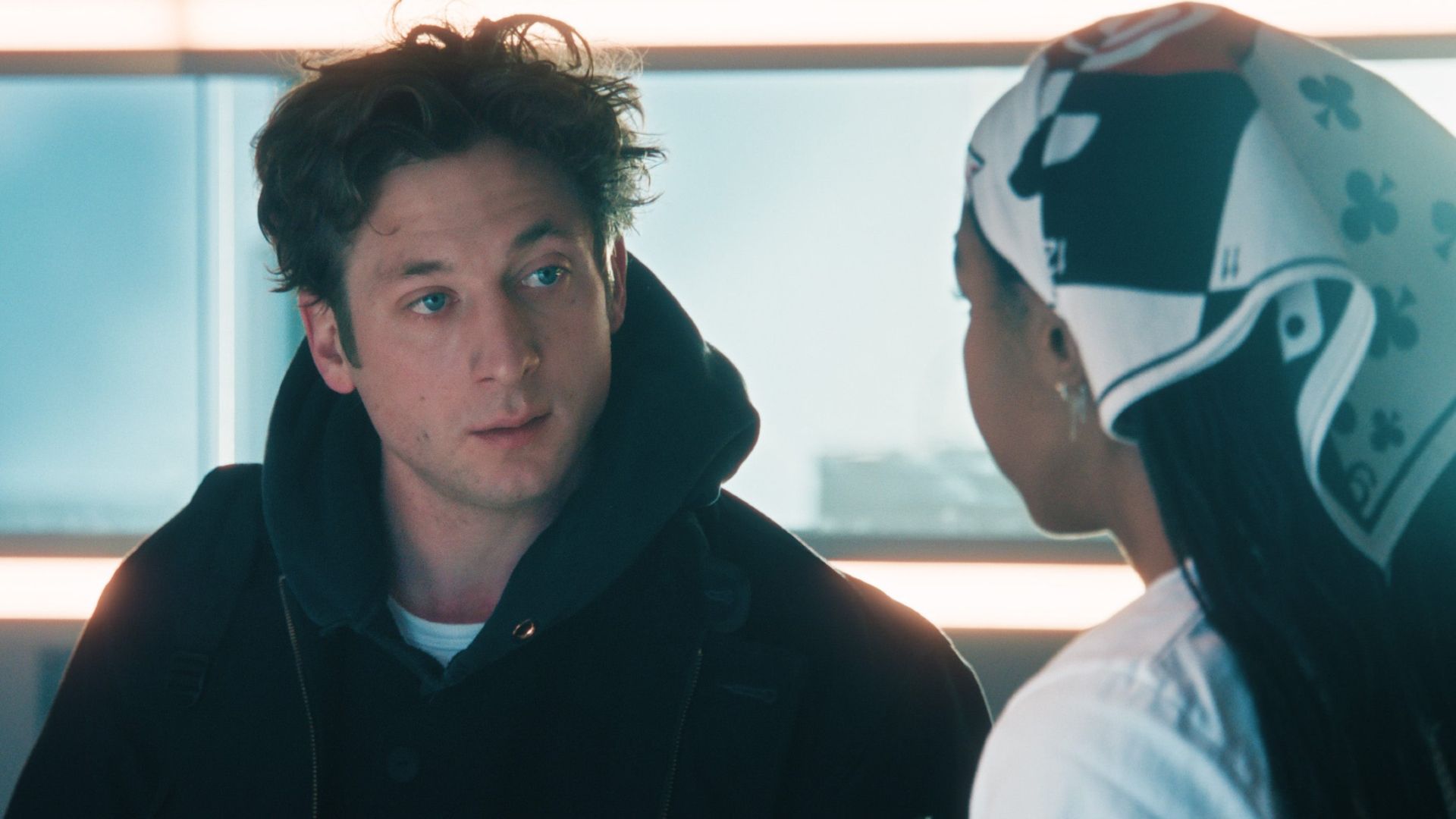
Even though the fourth season of FX/Hulu’s culinary comedy-drama thing The Bear wrapped up with a cliffhanger — Carmy (Jeremy Allen White) announcing his intention to quit and leave The Bear to Sydney (Ayo Edebiri), Richie (Ebon Moss-Bachrach) and Natalie (Abby Elliott), all while Uncle Jimmy (Oliver Platt) was planning to close the place down — it never felt like a fifth and final season would require many answers to big questions or resolutions to narrative mysteries.
It’s surprising, then, that the seventh episode of the fifth season, directed by creator Christopher Storer and written by Storer and Nicole Kohut, feels like such a satisfying and conclusive series finale for the Emmy-winning show. It’s a 52-minute episode that’s still breathlessly taut, mixing ticking-clock tension, grace-note moments for most members of the Bear ensemble, and beautifully shot food porn. And yes, several parts that made me laugh out loud, which I know isn’t the sort of thing I’m supposed to admit about a show whose awards classification as a “comedy” is one of the most contentious issues in our horribly fractured culture.
It isn’t a surprise that the seventh episode is so good. I’ve always been an appreciator of Storer’s anxiety-inducing glimpse into the kitchen at an evolving Chicago eatery — a hair less enthusiastic than the consensus for the rapturously acclaimed first two seasons, and then a hair more enthusiastic than the consensus for the backlash-driving third and fourth seasons.
The part that’s surprising, or maybe just confusing, is that although the seventh episode, titled “Caramel,” delivered everything I hoped for and expected from a series finale for The Bear, this is an eight-episode season. FX didn’t send critics the actual series finale yet, presumably out of fear of spoilers, but its absence has now filled me with trepidation and not excitement. It’s a feeling that I haven’t had since, well, this spring, when the penultimate episode of Hacks offered everything I required in a Hacks finale, ahead of an actual series finale that I liked some but not nearly as much as the installment before.
Then again, this was far from the only thing that perplexed me about the majority of the fifth season that I’ve seen.
As expected, season five picks up the day after the fourth season finale — which also happens to be the day featured in the last scene of “Gary,” the standalone episode that dropped as a May surprise and ended with its own, ultimately irrelevant cliffhanger. I didn’t love “Gary,” which dedicated a lot of time to Richie and Mikey (Jon Bernthal), two characters who work better when integrated into the ensemble than when anchoring a full hour. I like it even less knowing that its connection to the final season is, at most, limited.
Anyway, things continue to be tenuous at The Bear, as Sydney, Richie, Natalie and Carmy are forced to adjust to their new status quo, with a wholly undefined new power structure. Nobody else is privy to their conversation from the season 4 finale, a secret you know won’t last very long. Even if the rest of the staff was aware that Carmy intended to leave, they have other worries, specifically that the giant digital clock in the kitchen has hit zero.
That means that The Bear is on the brink of shutting down, which is ill-timed given Marcus’ (Lionel Boyce) new status as one of Food & Wine‘s best new chefs. As Jimmy is looking for options to simultaneously cut costs and jettison the property entirely, Sydney is trying to figure out how to do a dinner service with a pantry that’s nearly empty and a former mentor/partner/colleague, in Carmy, who is very bad at actually ceding control. From Marcus to Tina (Liza Colón-Zayas) to Neil (Matty Mattheson) to Ebra (Edwin Lee Gibson) to Gary (Corey Hendrix), everybody who has learned new skills over four seasons is staring down a job market that may require that they take steps backward, professionally.
It’s raining on a near-Biblical scale, messing up traffic in Chicago, possibly messing up their reservation technology, and soon presenting the risk that the ill-prepared restaurant may come crashing down in ways that are literal rather than symbolic.
The dinner rush approaches and it will be the most important service of everyone’s lives, but will it also be their last?
That plot summary sounds like the description for a premiere — possibly just for the opening minutes of the premiere — but that’s what the final season of The Bear is. It’s one, wholly serialized day and night at the restaurant, not quite told in real-time but without interruption for extended flashbacks or outside episodes.
For viewers convinced The Bear has, post-season one, fallen prey to arty, pretentious noodling, the promise of a paucity of gimmicks may be a blessing. But it’s hard for me to imagine a list of the series’ best episodes that doesn’t include one or two from “Fishes,” “Forks,” “Napkins,” “Worms” and “Bears.”
While having a clear and propulsive main story for a final season is good — and might be even better and more propulsive without the need for Jimmy, Computer (Brian Koppelman) and new addition Cheese (Elsie Fisher) to be on a separate mission best described as “exhausting other options” — off-format episodes have been extremely good to The Bear. It’s a show that has thrived on taking risks, and the first six episodes here, leading up to the series finale that isn’t a series finale, are very safe.
But is “safe” the same as “playing to its strengths”? I’m less sure.
This is a show known for intimacy and authenticity, and this season is dominated by digitally augmented rain and heavily stylized interiors in which the restaurant feels like an evocative soundstage and not like a working eatery. It’s very artificial, but there’s little doubt that Storer, who directed six of the seven episodes I’ve seen, is embracing that artificiality. From the amoebic kaleidoscope of rain-diffused light to the pervasive lens flares to the carefully expressionistic silhouetting in doorways, every aesthetic choice is exaggerated, including the score from new addition Hans Zimmer. With the pressured amped up throughout, this season is less naturalistic and more like a Tony Scott-directed version of Kitchen Confidential.
The tone is pumped-up, driven by the characters and matching the stakes, I suppose. So Carmy is extra dreamy-eyed and glum. Sydney is extra unsteady and flustered. Natalie makes sure to have Donna (Jamie Lee Curtis) babysitting her child just for the extremes of energy that Emmy winner Curtis brings. Marcus chooses this, of all nights, to invite his father and thus his daddy issues into the restaurant.
And the Faks? It’s hard to imagine anybody, after last season, thinking that what the show needed was “More Faks,” but Neil and Ted (Ricky Saffieri) have to handle issues with the restaurant’s pipes. If you’re doubting that the show still somewhat thinks of itself as a comedy, I posit that no straight drama could withstand a multi-episode arc involving the Faks and plumbing. The season also features a return of the notorious “Original Berf” t-shirts that I’ve long used as evidence of the show’s comedy status.
Drama? Comedy? Whatever it is, the first six episodes are broad and the seventh is expansive.
Broadness and artificiality aside, the episodes leading up to the exceptional series finale that isn’t a series finale are filled with highlights, including reliable stalwarts Allen and Edebiri, whose chemistry (and the weird pocket of “will they or won’t they” viewers online) is acknowledged in a brief and amusing way. I mostly enjoyed the meta touches as Storer clearly parallels the ending of a restaurant and the ending of a television show, along with the implications that he and Carmy might have learned (or partially learned) similar lessons about the necessity, or lack thereof, of chaos in the creative process. And while I missed the brilliance that has often come from The Bear breaking with standard TV linearity, I can’t say that I didn’t appreciate the briskness of episodes mostly running under 30 minutes.
But, again, is acting out of expediency and the desire to streamline a conclusive end the same as delivering a final season representing the best of The Bear? Is the artificiality and structural restriction of the majority of the season a lure for a show on the verge of going thoroughly bonkers in its finale? Does Storer have one more gear of fabrication in store, a transition from Tony Scott to Dogville-style Lars von Trier? Or will the show’s final minutes be dedicated to the few unanswered questions that I honestly don’t need answered, since episode seven feels so right? We’ll have things to discuss afterwards.