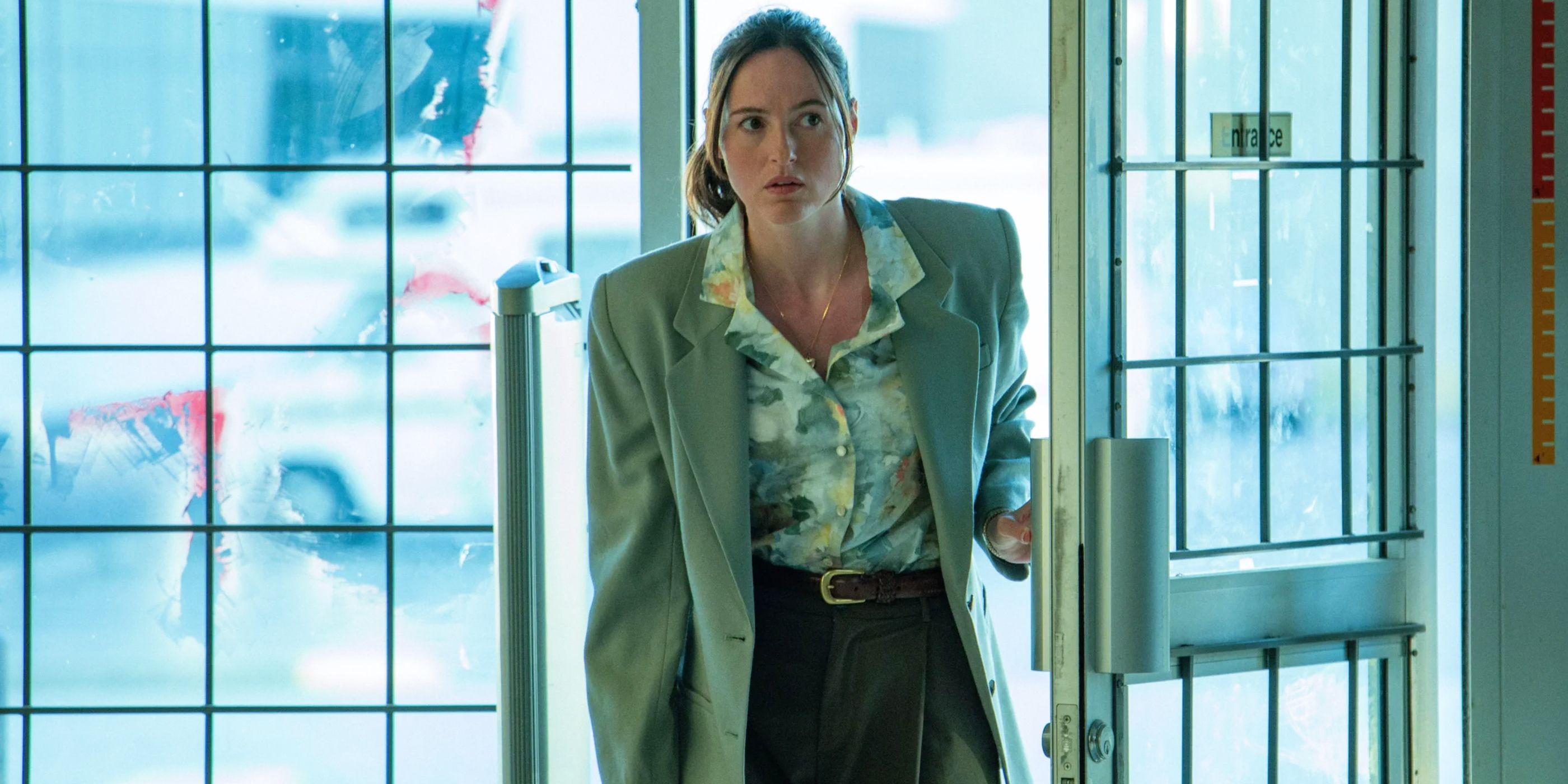
In a flashback sequence in episode three of Pluribus, protagonist Carol (Rhea Seehorn) and her partner, Helen (Miriam Shor), are transported to a Norwegian igloo hotel, roughly seven years before the Joining event. To the viewer, the glacial accommodation looks like the real thing: a frozen room intricately adorned with ice-carved sculptures. In reality, the characters are on a soundstage in the Canary Islands in a space crafted by production designer Denise Pizzini using translucent panels and Styrofoam blocks.
“My first thoughts were always, ‘How do we build this?’ ” Pizzini admits. “How do we make it look real and how do we light it?”
Pizzini worked with Paul Donachie, the cinematographer on the Vince Gilligan Apple TV series, to figure out the latter — specifically, how to illuminate a set so there would be no reflections from the lights or cameras in the ice. The pair first tried translucent panels made of a clear plastic that looked like molded ice, “but they were too translucent,” Donachie says.
“We went through a few materials crunched up behind them to give them more depth. We actually used some stuff that you use for softening lights in the end, and Denise’s team sort of crunched that up and that gave it some depth, it felt more real. And I experimented with lights above it and behind it,” he adds.
The structure and the wave-like art — including sculptures of koi fish — on the walls were carved out of Styrofoam. Then everything was hard-coated in plaster to look like real ice, using flecks of a “crystally thing that the light could pick up,” says Pizzini. Special effects then came in and blew fake snow on the ground and the walls to give them extra texture.
Still, the room didn’t look cold enough on camera, says Donachie, noting that in their research they found that designers light ice hotels with blue strip lighting under the furniture. “We added some haze that mixed in with the sparkly stuff in the walls and the special effects snow and the texture of the walls,” he explains. “We added some CG breath as well to the actors occasionally, and we had to put strip lighting in there. I originally thought it’d look great if it’s just white [lighting], but in the end, it worked with the LED lighting as well.”
To add to the complicated nature of the sequence, Donachie decided he would film the scene in a 360-degree, one-take shot. “Every inch of it was interesting to look at, so I suggested to [screenwriter] Gordon [Smith], ‘Why don’t we choreograph this in a way that the actors take us around the room, and we reveal the whole thing in one shot?’ ” he says. “He went for that idea, and he figured out what lines he wouldn’t mind off camera and what lines he needed on camera. With the camera operator, we figured out how to show this room, using the actors to take us around.”
The idea of a 360-degree shot impacted Pizzini’s design, although she made sure that nearly every inch of the space was dressed in case the camera panned to a particular part.
“We always design everything so there are no restrictions,” she explains. “So if they walk in and decide, ‘We’re going to do a 360,’ it’s ready. But they always surprised me — for example, [at one point], the camera’s looking down on the ground, so we have to accommodate for that, too. … Vince is always a production designer’s dream. He says, ‘Denise, I promise we’ll see everything.’ And he means it.”
Surprisingly, the ice hotel room wasn’t the biggest challenge for Pizzini or Donachie. It was the hallway that leads there. “In the script, it says that they go through this long [hallway], and I had this elaborate thing [planned],” says Pizzini, who had to scale down the set build to keep within budget. “It was like, ‘How do I reduce this set and still maintain this kind of magical feel to it?’ And then how we actually manufactured it was [still] kind of a challenge.”
Adds Donachie: “The talking dialogue was way too long for the set we had. We had to feel like you’re still moving along a continuous corridor when it was actually only 30 feet long. That’s why we did all those shots: the top shots, the side shots, all that kind of stuff gave us room to fit all that dialogue.”
So what’s happened to the elaborate set since the segment was shot? “I think it’s in a dumpster somewhere,” Pizzini says. “A few people may have nabbed a koi fish or two, and I know that we had these little plaques carved for the door of these little wood forest animals, I think those are at Vince’s Pluribus office, or in Gordon’s office. But I think it all went to the dumpster — I know, it’s heartbreaking, but it was captured at its best.”
Some of the Styrofoam for the ice hotel was reused for the body parts in the warehouse that Carol finds in episodes five and six after tracking milk cartons consumed by the Others. There was no VFX involved here, since Gilligan likes “everything practical,” Pizzini says.
“All those body parts are real,” she adds — “real” meaning handcrafted and not computer-generated. “It is a 100-foot warehouse, and these body parts are stacked. We had to do research on how you would actually butcher a body, and I had bins of torsos, heads, arms, legs, and then we shrink-wrapped them all,” Pizzini explains. “I called it the ‘body-carving circles’; I had people there just carving for a few weeks and making body parts.”